Zhuolin Wei
19/10/2020
This blog discuss about the impacts of COVID-19 on the economy in China and how Chinese people and government recover the business.
Introduction
Humans think that we have defeated other species by mastering instruments and collaborating on a larger scale and dominate the Earth. However, after 200,000 years, we still can’t mess with microorganisms and viruses around. To our body, virus means organ mutilation and death (Arnold 2016). To the economic field, virus brings pressure to production and fear to people’s heart.
The most comparable case of the novel corona-virus pneumonia (NCP) was SARS in 2003. However, the economic situation has changed since 2003 was the time of prompt production in China. We don’t have that rapid growth now compared to 2003. Meanwhile, the tertiary industry accounted for a larger portion in China’s economy. The tertiary industry, or the service industry, will be severely wounded. To be simply, people are forced to stay at home, then the tertiary industry is closed because nobody consumes. Those who are in the tertiary industry will be affected from employment, income to development opportunities. (Lee 2020)
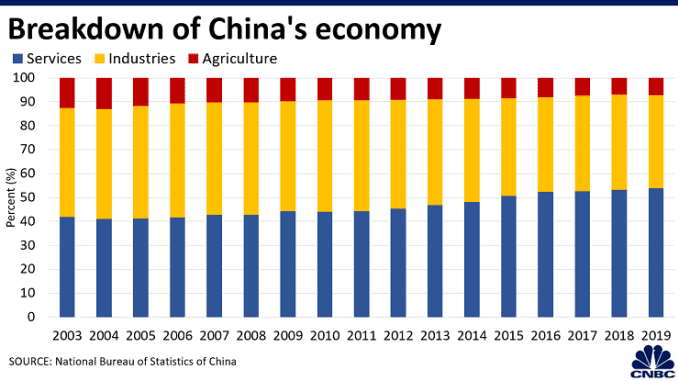
According to the graph, the proportion of tertiary industry in China is gradually expanding (blue part). It was 42% in 2003, and now is currently at 54%. The larger proportion of the tertiary industry also indicates that the epidemic will hit the economy more broadly this time.
Impact on Business
Those who benefits from this year’s incidence are the various online channels: Takeaway platform, fresh product platform, and errand platform developed online business with offline supermarkets through third-party e-commerce platform. Correspondingly, shopping malls shortened their business hours; entertainment venues closed their stores; offline brick and mortar stores and restaurant were only operating in a limited time; cinema, theater show were also closed or postponed (Tholet 2020). However, they still had to pay for the rent and labor where almost no business came. Those with healthy cash flow could probably carry on for a while, but it was like a death warrant for those with bad cash flow. Even Xibei (one of the biggest restaurants in HK) issued a notice declaring that their cash flow would not carry on anymore, It is not hard to image other brand would be even more suffering (Bradsher 2020). The Chinese government subsequently introduced relevant measures to give merchants preferential treatment from various aspects. Banks also helped with loans and by extending the deadlines. To reduce business’s operating cost, Big businesses like Wanda Group, Longfor properties, and China Resources carried out rent reduction or exemption for their commercial tenants. The scale of relief was up 4 billion CNY (China Tax 2020)
Impact on Manufacturer
Most manufacturers in China are located in manufacturing province and highly labor-intensive. Epidemic causes shortage of workers after break. The cost of production rises therefore the supply decreases. In addiction, the epidemic postponed the time workers return to their positions. Workers will have to work extra hours to keep up with previous demand. From basic staff to the manager, all of them are facing a deep, dark vortex. This is a common problem that all the manufacturers must face, those manufacturers might include toys, parts, alliances, furniture, stationery, packaging, paper making factories and so on. Most of them do not have a healthy cash flow affected by shrinking foreign trade, environmental protection policies. The pressure from insufficient domestic demand and rising costs was there as well. Some may survive the storm with the special care given by government and banks, but the rest must find a way to save themselves (Canton Government 2020)
Conclusion
The epidemic does influence the economy, but we are also orderly trying to support and regulate. After the epidemic, it is likely to return to normal. The epidemic is not only a war of time and life, it is also a war of time and faith. The sooner production resumes, the less impact it has on the economy.
References
Arnold C. 2016. “The Viruses That Made Us Human”. Available at: https://www.pbs.org/wgbh/nova/article/endogenous-retroviruses/ (Accessed on 17/10/2020)
Bradsher K. 2020. “While the World Spends on Coronavirus Bailouts, China Holds Back”. Available at: https://www.nytimes.com/2020/04/09/business/economy/coronavirus-china-economy-stimulus.html (Accessed on 17/10/2020)
Canton Government. 2020. “疫情期间,对制造业的扶持,来点实际的!” Available at: https://new.qq.com/rain/a/20200424A0MT5900 (Accessed on 19/10/2020)
China Tax Government. 2020. “支持疫情防控和经济社会发展税费优惠政策指引”. Available at: http://www.chinatax.gov.cn/chinatax/n810341/n810755/c5145868/content.html (Accessed on 19/10/2020)
Lee, Y. 2020. “5 charts show why the global economy is more vulnerable now than during SARS”. Available at: https://www.cnbc.com/2020/02/05/coronavirus-how-china-economy-has-changed-since-sars.html (Accessed on 17/10/2020)
Tholet R. 2020. “After the pandemic - how Covid-19 will impact bricks and mortar”. Available at: https://www.investec.com/en_gb/focus/prime-property/how-covid-19-will-impact-bricks-and-mortar.html (Accessed on 17/10/2020)
Comments
Post a Comment